Does SEO Still Matter in the Age of AI Search?
Yes. SEO still matters, but it now supports visibility in both traditional search results and AI-generated answers. Google says its established SEO practices remain relevant to AI Overviews and AI Mode. Google Search Central The durable foundations have not disappeared. What has changed is where answers appear, how sources are selected, and whether discovery produces an immediate website click.
Yes, SEO still matters, but its job has expanded
SEO remains necessary because search engines and AI-answer systems still need accessible, understandable, useful information from the web.
Google says the same established SEO practices used for conventional search also apply to AI Overviews and AI Mode. A website does not need special AI markup, a dedicated AI text file, or a separate technical optimization system to become eligible. Google Search Central
That makes the answer to “Does SEO still matter in the age of AI search?” clear: yes, but organic visibility now takes more forms.
A potential customer might discover a business through:
- A conventional organic search result
- A supporting link inside an AI-generated answer
- A cited source
- A brand or product mention
- A later direct visit after completing part of their research elsewhere
SEO still provides the foundation for these opportunities. AI-assisted search adds another layer through which useful web content may be found, interpreted, summarized, and presented.
This broader role matters because the search journey is no longer defined by one ranking followed by one click. A person may encounter several sources, compare an AI-generated summary with conventional results, refine the question, and visit a website only when they need more detail or are closer to making a decision.
The goal is therefore not to replace SEO with a new discipline. It is to build a website that can be discovered and understood across both conventional and AI-assisted search experiences.
What AI search has changed
Traditional search often presents a list of pages and asks the searcher to choose which result to open.
AI Overviews and AI Mode can take a different approach. They may generate a direct response, run related searches across several subtopics, and display selected supporting links alongside the answer. Google explains that these systems can use query fan-out to identify relevant webpages and that the sources shown may vary between features, models, and responses. Google Search Central
This changes how visibility works in several ways.
First, a single query may lead the system through several related searches. A page can therefore become relevant because it addresses one useful part of a broader question, even when it is not the most obvious result for the original wording.
Second, the source set is less stable. Different AI features or repeated searches may produce different links. A visible citation is not a permanent position that a business can expect to hold.
Third, the answer may satisfy some of the searcher’s immediate need before they visit any website. This can reduce clicks on informational searches.
A Pew Research Center analysis of Google browsing activity found that users clicked a traditional search result during 8% of visits in which an AI summary appeared, compared with 15% of visits without one. Only 1% of visits containing an AI summary produced a click on a source within that summary. The findings reflect U.S. browsing behavior during the study period rather than every query, market, or future version of Google Search. Pew Research Center
These figures do not mean that website visibility has stopped mattering. They show that rankings and traffic alone no longer describe the whole discovery environment.
A business may influence a potential customer before receiving a click. Its information might support an answer, reinforce a comparison, introduce the brand, or help the searcher decide which sources deserve further attention.
The challenge is that these effects are harder to observe than a conventional ranking and click.
What has not changed
Important pages still need to be crawlable, indexable, useful, and easy to reach through internal links.
Google also continues to recommend a good page experience, important information in readable text, relevant supporting images or videos, and structured data that accurately matches the visible page. Google Search Central
A page must be indexed and eligible to appear in Google Search with a snippet before it can be shown as a supporting link in AI Overviews or AI Mode. Meeting these conditions does not guarantee selection, but failing to meet them removes the opportunity. Google Search Central
These practices are not outdated preliminaries waiting to be replaced by “AI SEO.” They help search systems:
- Find a page
- Access its content
- Understand its subject
- Connect it with related pages
- Assess whether it may be useful
- Determine whether it is eligible to appear
The fundamentals also serve the visitor. Clear navigation, readable content, accurate information, and a usable page make it easier for a potential customer to understand the business and decide what to do next.
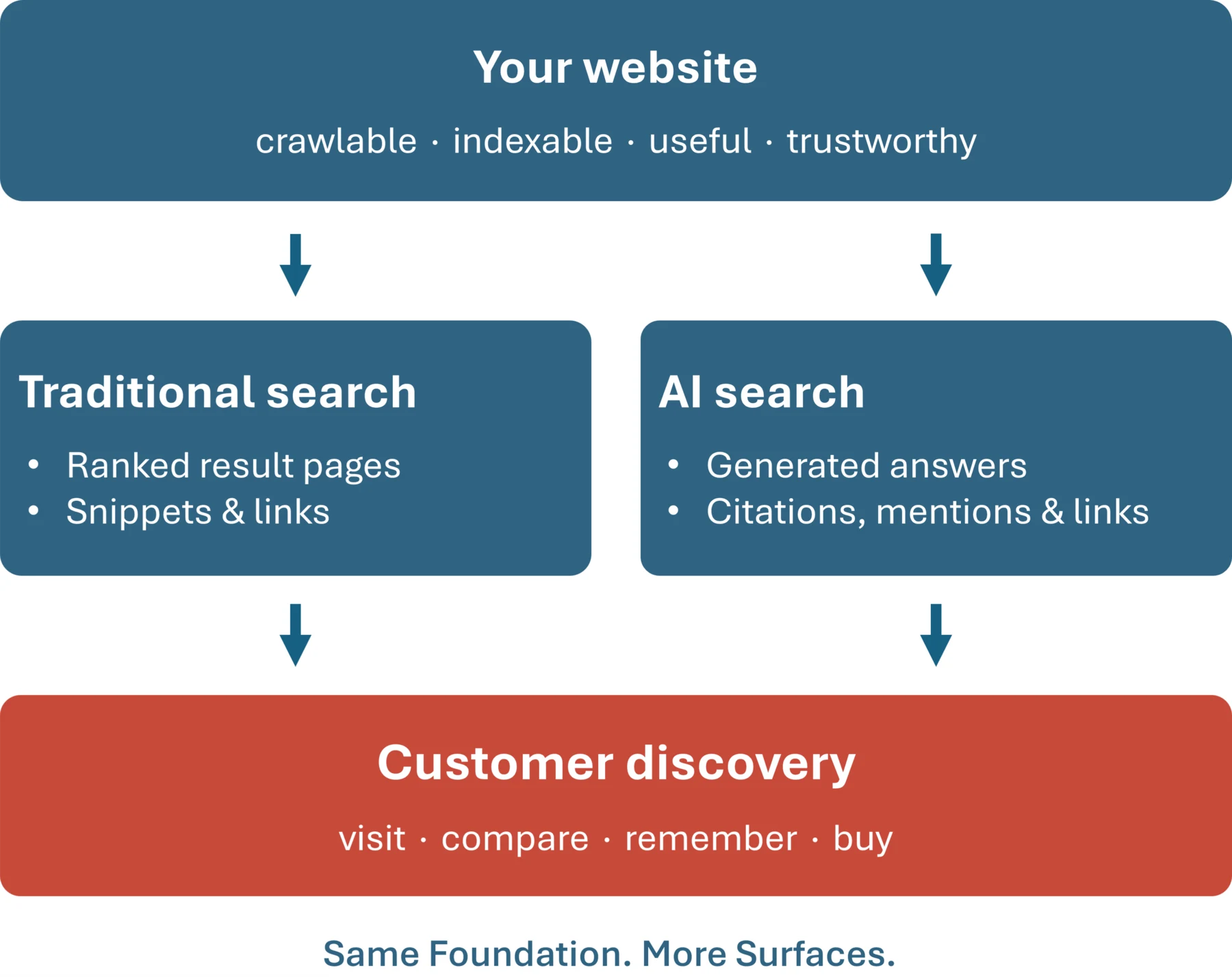
Modern SEO must work for answers as well as rankings
A useful modern page should make its main answer easy to identify.
It should then support that answer with clear reasoning, relevant detail, evidence, and a logical route to deeper information. Important claims should not be buried beneath a long generic introduction. Essential information should not exist only inside an image, video, script, or downloadable file.
Google recommends keeping important content available in text and ensuring that pages are discoverable through internal links. Google Search Central
This helps both people and search systems. A reader can quickly decide whether the page is useful. A retrieval system has clearer material to interpret and potentially use as a supporting source.
The objective is not to write for an imagined machine instead of a customer. It is to remove unnecessary ambiguity.
A page about a service should explain what the service is, who it is for, what problem it addresses, and what the visitor can do next. An educational page should answer its central question, explain the important conditions, and provide enough substance to be useful on its own.
This does not require chasing every new acronym or adopting unverified tactics.
Google says its AI search features do not require special AI-specific schema, new machine-readable AI files, or a separate set of technical requirements. Google Search Central
The practical standard is simpler: create a page that deserves to help a person directly and is clear enough to function as a supporting web source when an answer system retrieves it.
What a small business should prioritize now
A small business does not need to become an AI-search specialist. It does need to protect the fundamentals and make deliberate choices about the pages that matter most.
Start with search eligibility.
Confirm that important pages can be crawled, rendered, indexed, and reached through the website’s navigation and internal links. This includes pages that can attract a potential customer and pages that help someone understand, compare, or buy.
A technically inaccessible page cannot earn a conventional search result or become an eligible supporting link in Google’s AI features. Google Search Central
Next, give each important page one clear job based on a real customer question or decision.
The page should make its purpose obvious. It should answer the central question early, remove filler, and explain what the visitor needs in order to understand the subject or take the next step.
A useful page may include:
- Specific business information
- Clear explanations of products or services
- Credible evidence
- Firsthand knowledge
- Relevant examples
- Accurate answers to common questions
- Internal links to closely related information
These details should be added because they improve the answer, not because they make the page longer.
Then strengthen the signals beyond the page itself.
Consistent business information, reputable mentions, earned links, reviews, and independent discussion can help potential customers verify that the business exists and is worth considering. These signals may also give search and answer systems more context about the business.
Avoid responding to AI search by publishing a large volume of interchangeable text for minor keyword variations. Pages without a clear purpose create more material to maintain without necessarily improving visibility or helping customers.
A smaller collection of useful, distinctive pages is usually a better use of limited resources than a catalogue of shallow answers.
When considering SEO vs AI search, do not treat them as competing investments. The same strong website foundation supports both. The newer task is to make sure the content remains useful when part of the search experience happens inside an answer interface rather than entirely on the website.
SEO cannot guarantee traffic, AI citations, or customers
No SEO tactic can guarantee a ranking, a click, inclusion in an AI-generated answer, or a sale.
Even a page that follows technical requirements and recommended practices may not be crawled, indexed, ranked, cited, or selected as a supporting source. Google Search Central
Results depend on many factors, including:
- The query
- Search intent
- Competition
- Location
- Website authority
- Technical quality
- Content quality
- Available evidence
- Customer demand
- Changes made by search platforms
Some of these factors can be influenced. Others remain outside the business’s control.
SEO should therefore be treated as a way to improve eligibility, relevance, credibility, and opportunities for discovery. It should not be presented as a promise that every action will produce a predictable result.
This distinction is especially important in AI-assisted search, where source selection can vary between searches and systems. A citation observed today is not a guaranteed placement tomorrow.
The sensible response is to improve the signals the business can control, measure the available evidence, and avoid building a strategy around isolated appearances.
Measure visibility, not just rankings
Rankings and organic traffic remain useful, but they are no longer a complete scorecard.
Continue monitoring impressions, queries, pages, clicks, and conversions through Search Console and analytics. Google currently includes appearances and traffic from AI Overviews and AI Mode within its overall Web performance reporting rather than providing a separate search type for each feature. Google Search Central
This makes it difficult to isolate every effect of Google AI search. It also means that website owners should avoid drawing firm conclusions from one manual search or one apparent citation.
Use several forms of evidence together.
Review whether:
- Important pages are indexed
- Relevant search impressions are growing
- Qualified visitors reach priority pages
- Visitors complete meaningful actions
- The business appears for relevant customer questions
- Priority pages remain accurate and competitive
- Reputable websites mention or link to the business
- Organic discovery contributes to enquiries or sales
Manual checks of AI responses can provide context, but they are snapshots. The sources and links may change between features, models, queries, and repeated runs. Google Search Central
The practical conclusion is to keep doing SEO without defining success as winning one blue-link position.
Build a website that can be discovered, understood, trusted, cited, visited, and used by a potential customer wherever the search journey begins.
Attract more customers from Google and AI search without ads or an agency
Understanding why SEO still matters can stop you from abandoning durable practices or chasing every new AI-search tactic.
It does not tell you which website fixes, keywords, pages, content improvements, authority actions, and measurements deserve your limited time first.
The Visibility Kit for Google and AI Search closes that gap with a priority-led workflow, practical guidance, checklists, workbooks, templates, monitoring, and AI-assisted prompts. It turns the principles in this guide into a structured path for improving visibility across your website.